
6 Steps To Starting A Meditation Routine
Are you interested in creating a meditation routine? Learn how to start meditating with these 6 easy steps.

I’ve always been anxious about family, money, life, and whatnot. About three years ago, I learned how to create a simple meditation routine that fits my lifestyle using a mix of meditation apps. Now, I’ve perfected a meditation habit that works wondrously with my daily schedule, and I will show you how to do the same.
Being more mindful, calm, and relaxed will involve slowing down and spending some quiet time with yourself, and this is best done in the form of a classical meditation! Meditating can be a foreign and somewhat tricky practice, especially for those who are constantly rushed, overthinking, and under pressure. Still, it’s a great tool to use to become more serene.
In this article, I’ll cover the basics of creating a meditation routine and how you can use it to your advantage and achieve an undisruptable state of calmness.
Without further ado, let’s get to it, shall we?
What is Meditation?
In short, meditation refers to a practice that involves a neutral state of mind that does not latch onto thoughts or emotions but observes them instead.
India’s technique enhances self-awareness, mental well-being, calmness, and serenity by reducing overthinking, anxiety, and stress.
Meditation is an excellent form of self-care people use to help them deal with anxiety, stress, depression, and everyday life. It’s a technique to focus on a single thought and eliminate unnecessary thoughts and distractions.
Though creating a meditation routine may seem complex at first, meditation is, at its very essence, effortless. So, let’s look at the actionable steps you can take toward achieving a meditative state of mind!
Where do I Start?
To a certain extent, people may have made meditation seem like an esoteric, borderline magical practice. This leads to the belief that meditation is hard to do, and indeed, it may seem like it is not for everyone.
However, anyone can meditate as it interacts with the brain and its different work modes and thought patterns. To simplify, I’ve broken it down into a step-by-step process for creating the perfect meditation routine, so let’s look!
How To Create A Meditation Routine
Step 1: Setting
Before you create your meditation routine, it’s essential to find a quiet spot where you can sit and relax without being disturbed – a closed room, a peaceful location in the garden, or a communal meditation class will be perfect.
Expert meditators like to burn incense or candles and play relaxing music in the background. Ensure that the room temperature isn’t too hot or cold and that you have a comfortable cushion or chair. I like to meditate in the mornings while doing yoga or quietly during my lunch break in one of the unused offices.
This will allow you to focus less on sensory information and more on your inner world. Cresting the perfect meditation setting will allow you to build on your focus and concentration skills.
Step 2: Timing
Meditation beginners should meditate for a shorter time – set the timer for 5-10 minutes and increase the daily time limitations as you get more accustomed to the practice.
Some people meditate between 30-60 minutes daily, but this doesn’t mean you must do it all simultaneously. For example, you can divide the time between morning and afternoon.
Ultimately, the goal is to lose track of time—don’t over-fixate on the time spent meditating but rather on the quality of the meditative state. If you prefer a set time for meditation, you can use a guided timer or instructional meditation video/podcast.
Step 3: Become Body Aware
Once you’ve comfortably nestled into your meditation spot, it’s time to notice your body – Close your eyes and become fully aware of your physical body while closing your eyes.
During this pre-meditative state, you should ensure you feel comfortable. You can also bring awareness to all body parts, starting from the toes and working your way up. Another great way to practice body awareness is through yoga. In yoga, you must focus on your breathing and how each body part connects to the other, which is excellent for meditation.
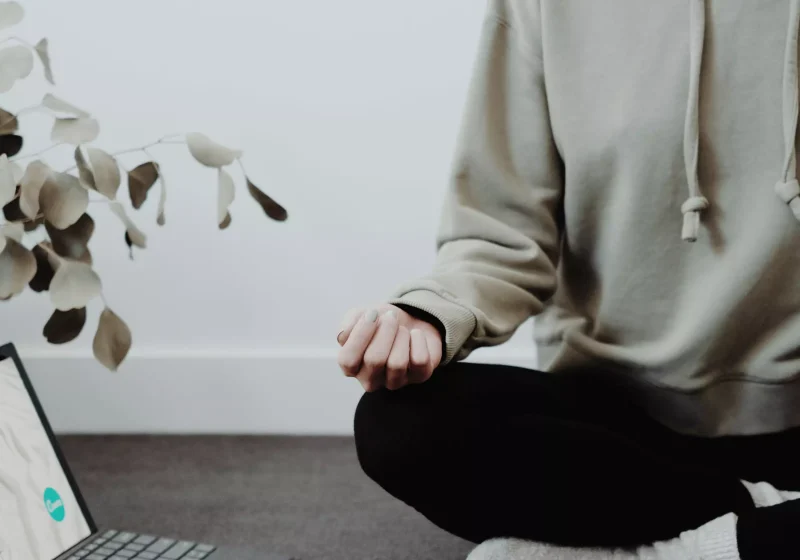
Step 4: Breathing & Heart Focus
Once you’ve made sure you are comfortable and in a calm environment, it is time to get to the core of your meditation – Breathwork & heart focus.
Breathing is one of the key ingredients to a successful meditation session. Though not mandatory, it is a powerful tool that can quickly induce a meditative state.
- Breathe in deeply through your nose for 3-5 seconds
- Pause briefly and exhale slowly, taking the same time you took on the inhale.
- Focus on this breathing pattern – 3-5 seconds on the inhale and 3-5 seconds on the exhale.
During your meditation journey, you can try many different breathing exercises. Find the one that suits you the best and stick with it.
In the beginning, you will consciously breathe like this, but this breathing tempo will become automatic in just a few minutes.
While breathing slowly, focus on your heart and notice how it works. If you come to meditation from a stressful workday, your heartbeat may be quicker. Release tension with each exhale and send a powerful relaxation signal.
In doing so, you can calm your heart down. Notice how your heart rate drops as you continue your slow breathing pattern. Throughout your meditation session, you should focus your breath on the sensation of your lungs filling up with air and leaving the body and your heartbeat.
In a full-on state of meditation, your breath will be slow and deep, and your heart will do more diminutive but more powerful beats.


Step 5: Keep Track of a Wandering Mind
Contrary to popular belief, the goal of meditation is not to turn off your entire thought process.
At one point or another, your mind will start wandering, so meditation aims to pay attention to this when it happens and CHOOSE not to follow any thoughts and make them into a story.
When you focus on your heart and lungs, and an intrusive thought comes to mind, try to swipe it away and bring your awareness and focus back to your lungs & heart. In meditation, you want to be mindful of how your thoughts affect you.
Step 6: End on a Kind Note
Once your time for meditation has run out, gently end the session by taking a moment to notice your surroundings—the sounds and the sights. Be kind to yourself now and notice your thoughts, feelings, and emotions—even if you still feel slightly stressed. You can continue practicing meditation daily until you reach a calmer general state.
Namasté
I hope you found these steps for creating a meditation routine easy to follow. Even though meditation can be tricky initially, it becomes pretty simple once you practice it more often – you have to start somewhere! Bringing yourself into a calming state is essential for a healthy body and mind. Meditation is your first step to serenity.
Find a quiet spot, sit, close your eyes, and start breathing, and remember that with time, meditation will become a STATE that you can maintain throughout most of your wake life.
Remember your surroundings, time of day, and present emotions when creating a meditation routine. Remember, meditation is about grounding yourself and being in the present moment.
Namasté!
Do you have a basic meditation routine? Let me know in the comments.


This is really helpful Seriah. One of my goals for the New Year is to meditate more often in order to help with anxiety. I’ve bookmarked your post so I can go back to read again 🙂
Vourneen,
That’s great! Good luck on this journey.
This is so helpful as I have wanted to find a way or incorporating meditation into my life/day and was a bit overwhelmed with where to start — thanks for this!
Hi Molly,
Once you find a set of habits and routines that work for you, it becomes easier to implement.
Your post has reminded me that I need to get back into meditation. I used to be able to meditate daily for a month straight before. What helped me was saying “just one minute” so that it was easy to commit to! I will definitely restart it again, incorporating your tips here. Do you have any meditation apps that you recommend? 🙂
Hi Izzy,
My favorite meditation apps are Insight Timer and Headspace. I highly recommend giving both of these a try as you ease back into meditation. At the beginning of my meditation journey, I have been using a tip I learned from a podcast called the Mindset Mentor. Take a calendar and put a red X for every day you meditate or complete your goal. As the days go by, you’ll start to see a streak, and you won’t wanna break it.
Mediation is something that I find intriguing. I appreciate this post and how it breaks down the process. I can’t imagine getting to a point where someone could sit for 60 minutes! I would definitely have to break that down. I’ve heard that there is a sect of Monks that can control their heartbeat through mediation. That’s pretty powerful. So amazing that through a focus like that we have power over our bodies. After reading your post, I’m even more intrigued and plan on learning more.
~Cassie
Cassie,
WOOW! I didn’t know there were monks who can control their heartrate. That’s scary and so intriguing. It reminds me of just how powerful the human body and mind actually is.